
Handmade Christmas cards don’t require drawing skills or a craft room. A printable coloring page already gives you clean line art, so all you add is color, a fold, and a few kind words. The result feels personal, and the process makes a calm December activity for a quiet evening or a family table.
This guide is for anyone who enjoys coloring and wants to share their pages instead of filing them away. You’ll learn which paper to use, how to scale a full-page design to standard card sizes, which coloring tools work on heavier paper, and how to finish and mail your cards without surprises.
Pick a design that reads well small
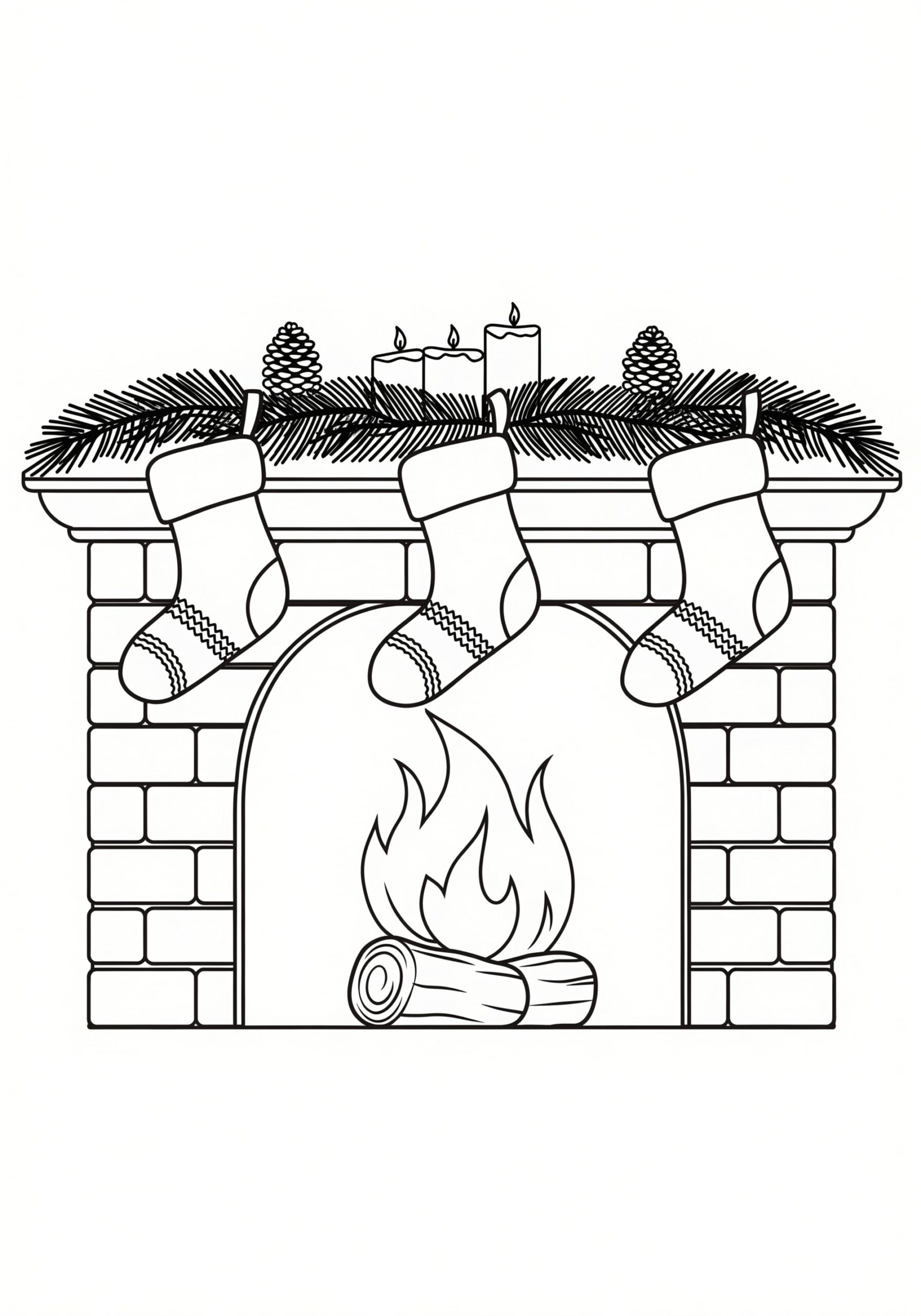
Not every coloring page works on a card front. Look for a clear focal point and bold outlines that stay readable when the image shrinks. A cozy scene like our Printable Advent Coloring Page with a fireplace, Christmas stockings, and garland is a good fit, because the mantel shape still reads clearly at postcard size.
Very fine patterns with tiny spaces are harder to color once reduced. If you love a detailed page, crop it instead of shrinking it. A single stocking or a section of garland can make a charming card on its own.
Choose cardstock that folds cleanly
Regular printer paper (20–24 lb, about 75–90 g/m²) feels flimsy as a card and buckles under markers. For a folded card, use cardstock around 65–80 lb cover (about 176–216 g/m²). It runs through most home inkjet and laser printers and still folds neatly.
Heavier cardstock, around 100–110 lb cover (270–300 g/m²), feels sturdy but may jam some home printers and can crack along the fold. Check your printer’s manual for its maximum paper weight. Smooth, bright white stock gives the crispest lines and the most even color.
Scale the page to standard card sizes
The two easiest card sizes come straight from a US Letter sheet (8.5 × 11 in, 21.6 × 27.9 cm). Cut the sheet in half to get 5.5 × 8.5 in, then fold it to an A2 card of 4.25 × 5.5 in (10.8 × 14 cm). For a larger A7 card of 5 × 7 in (12.7 × 17.8 cm), you’ll need a 7 × 10 in piece folded in half.
To fit a full-page design onto an A2 front, print it at about 45–50 percent, or use your printer’s "2 pages per sheet" setting. Leave a margin of at least 1/4 in (6 mm) around the design so nothing gets trimmed. Print one test copy on plain paper first to check placement before using cardstock.
Color with tools that suit cardstock
Colored pencils are the most forgiving choice on cardstock. They layer well, won’t bleed through, and let you add soft shading to firelight or stocking folds. Fine-liners and alcohol markers give bolder color, but test them on a scrap first, since some inks feather on certain papers.
A white or metallic gel pen adds small highlights to ornaments, garland lights, or snow. Keep accents flat rather than gluing on thick embellishments, which can snag in the mail. Let ink dry for a few minutes before folding to avoid smudges.
Fold, finish, and mail the card
Score before you fold. Run a bone folder or the back of a butter knife along a ruler at the fold line, then crease firmly. This gives a straight edge and keeps cardstock from cracking.
For a polished look, color the design on a separate panel, trim it about 1/4 in (6 mm) smaller than the card front on every side, and glue it onto a folded card base in a solid color. Red, deep green, or kraft brown frame a colored scene nicely. Use a glue stick or double-sided tape, since liquid glue can warp the paper.
Buy envelopes before you finish the cards: an A2 card fits an A2 envelope (4.375 × 5.75 in, about 11.1 × 14.6 cm), and an A7 card fits an A7 envelope (5.25 × 7.25 in, about 13.3 × 18.4 cm). Lumpy, square, or unusually thick cards may need extra postage, so check your postal service’s rules if you add raised details. Also review the license of any printable you use; designs sold for personal use are usually fine for cards you give to friends and family, but not for selling.
Making Christmas cards from coloring pages comes down to a few simple steps: pick a design that reads well small, print it on 65–80 lb cardstock at card size, color it with tools that suit the paper, then score, fold, and match it to the right envelope. Start with a single test card this week, and you’ll soon have a small stack ready to mail. If you’d like a festive starting point, the fireplace and stocking scene of our Printable Advent Coloring Page makes a cheerful first card front.